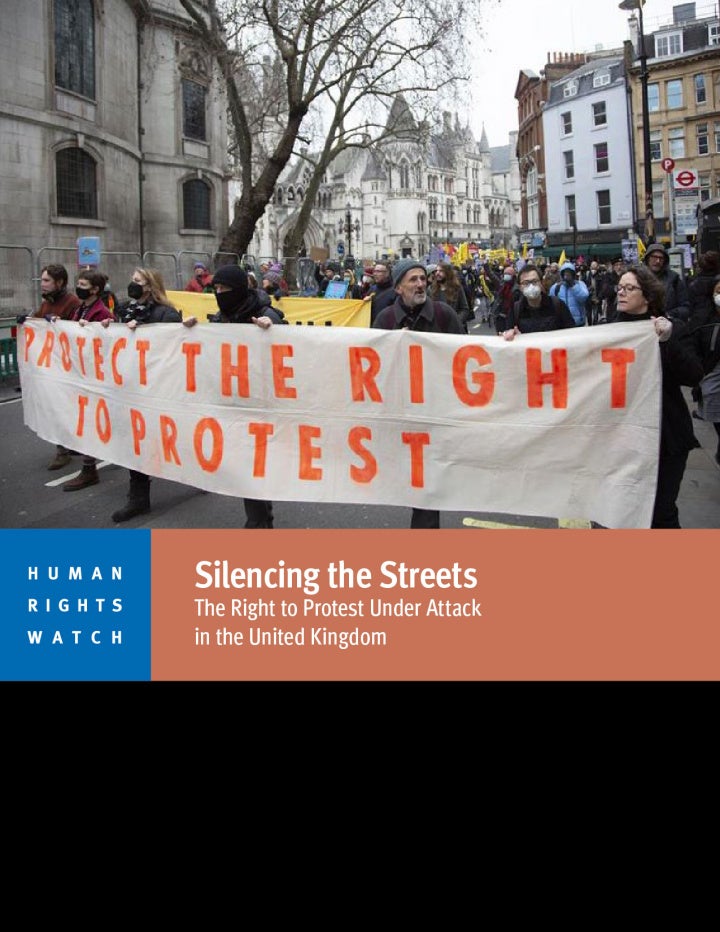
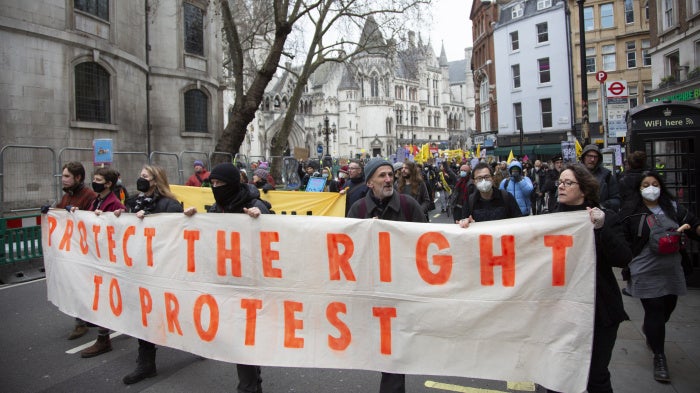
The Right to Protest Under Attack in the United Kingdom
The 47-page report, “‘Silencing the Streets’: The Right to Protest Under Attack in the UK,” documents that the UK’s Labour government has failed to reverse sweeping anti-protest laws introduced by the previous Conservative government. Instead, Labour has attempted to expand them with the Crime and Policing Bill 2025 and through the unprecedented misuse of terrorism legislation to target and criminalize peaceful protest. The Crime and Policing bill, pending before parliament, is to be debated in the House of Lords in January 2026.
The report details a range of human rights violations against the academic community, defined as persons teaching, studying, researching and working at an institution of higher learning.
On November 29, Egyptian voters will go to the polls to elect 444 representatives to the People's Assembly, Egypt's national legislative chamber, which passes laws and nominates the President of the Republic every six years.
Labor Rights and Freedom of Expression in South Korea
Despite the South Korean government’s June 1987 promise of reforms, there is a wide disparity between the rhetoric of democracy achieved and the reality of the retreat from reform. The government of President Roh Tae-Woo has failed to deliver on promises of reform in two key areas: worker rights and freedom of expression.
Malawi is a land where silence rules. Censorship is pervasive: Orwell, Hemingway, Graham Greene, and Wole Soyinka are among hundreds of authors who have been banned. Dozens of Malawians suspected of critical views are detained without charge or have been unfairly tried.
Policies that Contribute to the Killings (A Middle East Watch Report)
This report examines three aspects of Israeli policy that have contributed to the frequency of unlawful killlings of Palestinians during the intifada. These are the open-fire regulations issued to Israeli troops operating in the occupied West Bank and Gaza Strip that are more permissive than what the internationally recognized standards of necessity and proportionality allow; the inadequate procedures followed by the Israel Defense Force (IDF) to investigate and punish troop misconduct against Palestinians; and the restrictions imposed by the IDF on independent bodies attempting to monitor its conduct in the occupied territories.
As Cuba approaches the 36th anniversary of its revolution, it is engaged in an extended crackdown on independent peaceful activity and its human rights practices continue to be subject to the whim of the executive. Among the targets of this crackdown are newly-emerged human rights groups, whose establishment in recent years had given the appearance of greater openness in Cuba.
The Committee to Protect Journalists and the the Americas Watch mission to Haiti from August 12-15,1984 to investigate a recent crackdown on the press.
A Fund for Free Expression Report by Meron Benvenisti
In its pre-publication review of Palestinian newspapers and magazines, Israel’s military censor blocks the publication not only of supposed national security secrets or material likely to incite violence. Rather, the censor’s primary concern, as shown through a study of banned materials, is to eradicate expression that could foster Palestinian nationalist feelings; suggests Palestinians are a nation with a national heritage; denies Israel’s legitimacy; or imputes behavior to Israeli officials that suggests illegitimacy. Palestinian editors must submit for review all material meant for publication, including photos, advertisements, and crossword puzzles. The censor’s list of banned books included some 1,600 titles, at the time this report was prepared.