"You don't have a house here anymore. You need to leave."
An Israeli soldier spoke those words to Leila E., a 54-year-old Palestinian refugee, before forcing her to leave her home in the Jenin refugee camp of the occupied West Bank exactly one year ago. Leila described the fear and panic she felt as Israeli soldiers stormed her family's home wearing masks and carrying machine guns.
That experience was part of a much larger shift still underway. What happened to Leila in Jenin in January 2025 was repeated in the Tulkarem and Nur Shams refugee camps during Operation Iron Wall, the large-scale Israeli military operation in the northern West Bank that emptied the three camps of some 32,000 residents. One year on, Leila and the other camp residents remain unable to return, part of the largest displacement of Palestinians in the West Bank since 1967.
The Israeli government launched Operation Iron Wall two days after a temporary ceasefire was announced between Israel and Palestinian armed groups in Gaza. Senior Israeli officials claimed the operation targeted militants. However, the mere presence of Palestinian fighters in refugee camps does not justify the forced displacement of all camp residents. The Israeli military has made no attempt to establish that the only feasible option was to completely evacuate the civilian population to achieve its stated military objective.
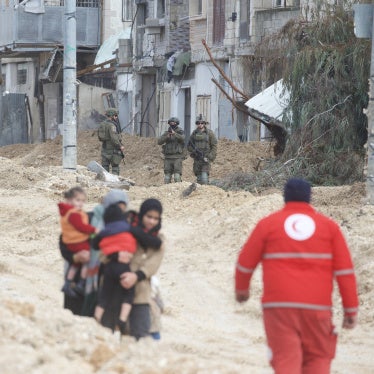
The organized, forced displacement of the camp residents has removed nearly all Palestinians from these areas, which had been their home for generations. Israel has gone on to raze, extend and clear entire sections of the camps to create widened military access roads off limits to the local population. Israeli soldiers have fired on people trying to reach their homes, allowing few to collect their belongings.
The laws of war are clear on this subject: In situations of occupation, civilians can only be relocated in narrow circumstances, including for imperative military reasons or to ensure civilian safety. Any lawful evacuation must be temporary, and residents must be allowed to return once hostilities in the area have ceased. Displaced civilians must also be provided with adequate support to meet their humanitarian needs, including shelter, food, water and medical care. When these conditions are not met, so-called evacuations breach international law, most likely amounting to the war crime of forced displacement.
In an October letter to Human Rights Watch, Israeli officials said they initiated Operation Iron Wall "in light of the security threats posed by these camps and the growing presence of terrorist elements within them." The letter did not explain why the displacement of the entire population of all three camps was necessary to achieve its aims, nor if it considered alternatives.
The brutal and violent military assault on these camps affected Palestinian refugees and their descendants, who were expelled or forced to flee their homes during the events surrounding Israel's creation in 1948, known as the Nakba. In a 105-page report, "'All My Dreams Have Been Erased': Israel's Forced Displacement of Palestinians in the West Bank," Human Rights Watch documented Israeli forces moving systematically through the camps, raiding homes, ransacking properties, interrogating residents and eventually forcing families to leave.
Nadim M., a 60-year-old resident of Tulkarem camp, told us that Israeli soldiers restrained him with zip ties, searched his property and ordered him and his family to leave. The soldiers warned that snipers positioned nearby would shoot if they turned left or right. Nadim said that no one told him where to go outside the camp or where to seek shelter.
Like Nadim M., residents sought shelter wherever they could: in the crowded homes of friends and relatives or at communal spaces such as mosques, where men and women in the family are separated. As they fled, residents watched bulldozers demolish their homes and other buildings. Some residents struggled to navigate the streets inside the camps—torn up by military vehicles—making it particularly difficult for older people and those with disabilities to cross.
Our analysis of satellite imagery found that, in the first six months of the campaign, the Israeli military demolished 850 homes and other buildings across the three camps. When camp residents challenged demolition orders, Israeli courts summarily rejected their petitions. For example, on Dec. 24, the Israeli Supreme Court rejected a petition filed by Adalah—The Legal Center for Arab Minority Rights in Israel—on behalf of 22 Palestinian residents of the Nur Shams refugee camp and surrounding areas whose homes were slated for demolition. As with previous petitions, the court accepted the Israeli military's claim that "legitimate military necessity" justified the demolitions.
At the outset of Operation Iron Wall, Israeli Defense Minister Israel Katz said the operation would last one year. It is now exactly one year later, and the camps remain emptied of Palestinians. The Israeli government has given no indication of when residents will be allowed to return, if ever. Instead, demolitions continue.
Israel's forced removal of 32,000 West Bank refugees is not a lawful evacuation. Rather, it is a war crime of forced displacement, with statements by senior Israeli officials highlighting these efforts as an intentional Israeli state policy. Major General Avi Bluth, commander of Central Command—which leads West Bank military operations—said the operations are designed to "change the character of the entire area." Minister in the Defense Ministry Bezalel Smotrich, who sits on the security cabinet and also serves as finance minister, warned that if camp residents continued what he described as "acts of terrorism," the camps would be transformed into "uninhabitable ruins," with "their residents forced to migrate and seek a new life in other countries."
Because Israeli efforts are widespread and systematic, the forced displacement of camp residents also constitutes a crime against humanity, in addition to war crimes, which the prosecutor of the International Criminal Court (ICC) should investigate. Israeli state actions to remove Palestinians from the refugee camps by violent means also amount to ethnic cleansing.
Human Rights Watch identified a list of senior officials who should be investigated for individual criminal responsibility for war crimes and crimes against humanity, including Prime Minister Benjamin Netanyahu and Defense Minister Katz. Despite the wealth of evidence and gravity of these crimes against Palestinians, Israeli government investigations into their own abuses have proven—as the premier Israeli human rights organization B'Tselem has described it—to be a "whitewash mechanism" that ensures impunity.
In parallel, governments should impose targeted sanctions against the Chief of the General Staff of the Israeli army, Lt. Gen. Eyal Zamir, alongside Bluth, Smotrich, Katz, Netanyahu and other Israeli officials implicated in ongoing, grave abuses in the Occupied Palestinian Territory. They should also impose an arms embargo on Israel, suspend preferential trade agreements with Israel, ban trade with illegal settlements and enforce all ICC arrest warrants.
Israel has adopted a strategy of forced displacement and ethnic cleansing in Gaza and in these West Bank camps. Concerned governments should not allow the one-year anniversary of Operation Iron Wall to pass without concerted actions to end these atrocities.