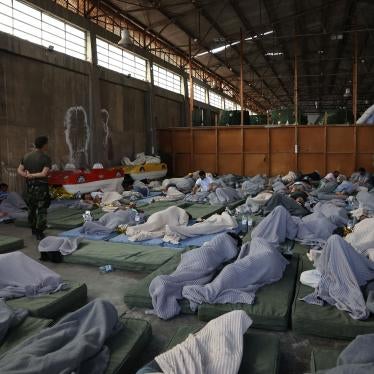
(Milan, January 27, 2026) – The trial, due to start this week, of 6 Italian officers for a 2023 shipwreck in which at least 94 people died is an important opportunity for justice for deaths of migrants and asylum seekers at sea, Human Rights Watch said today. The trial, following a postponement, is scheduled for January 30, in Crotone, Italy.
Two Italian Coast Guard officers and four Customs Police (Guardia di Finanza) officers are accused of negligence leading to a shipwreck and multiple counts of manslaughter in what has become known as the “Cutro shipwreck” after a nearby village.
“The Cutro shipwreck trial is a crucial opportunity to secure truth and justice for survivors and families of victims, and to help avoid future deaths,” said Judith Sunderland, acting deputy Europe and Central Asia director at Human Rights Watch. “It is not only the individual officers who are on trial, but also Italian state policies that prioritize deterring and criminalizing asylum seekers and migrants over saving lives.”
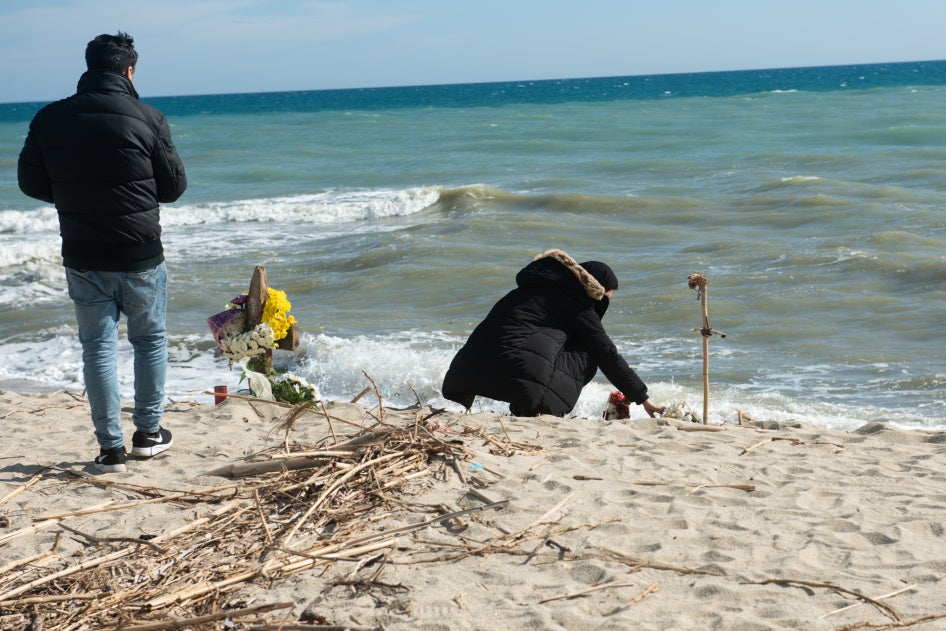
The courtroom where the trial is taking place is not far from where the wooden vessel sank in rough weather in the early morning hours of February 26, 2023. Only 80 people survived and 94 bodies, including of 35 children, were recovered. An unconfirmed number of passengers were never found. Survivors estimate that the boat was carrying between 180 and 250 people, most from Afghanistan, Syria, and Pakistan.
The EU border agency, Frontex, had alerted Italian authorities about the boat hours before it sank. Despite indications of distress—the observable lack of life jackets, thermal readings indicating a large number of people on board, and worsening weather conditions—Italian authorities did not activate a search-and-rescue operation. Taking a law enforcement approach, the Customs Police dispatched two patrol boats to intercept the boat, but they returned to port due to rough seas.
Following an investigation that took more than two years, the Crotone public prosecutor indicted the officers in July 2025. Sixty-five survivors together with six search and rescue organizations—EMERGENCY, Louise Michel, Mediterranea Saving Humans, Sea-Watch, SOS Humanity, and SOS MEDITERRANEE—are civil parties to the case.
More than 33,200 people have died or been reported missing in the Mediterranean Sea since 2014, according to the International Organization for Migration. The failure by Italy and other EU countries to respond promptly and appropriately to migrant boats in distress, as allegedly in the case of the Cutro shipwreck as well as the June 2023 shipwreck near Pylos, Greece, has contributed to this staggering death toll.
As the European Court of Human Rights in the case of Safi v. Greece made clear, Italy, as a party to the European Convention on Human Rights, is bound by obligations under the right to life, to take steps to safeguard the lives of those within its jurisdiction. That includes with timely rescue responses when lives are at risk.
Italian authorities also have obligations stemming from the International Convention on Safety of Life at Sea and the International Convention on Maritime Search and Rescue to act upon situations of distress at sea. The EU Regulation on Maritime Border Surveillance lists factors relevant to determining a situation of uncertainty, alert, or distress, including the seaworthiness of the vessel, the number of people on board in relation to the type of vessel, and the weather and sea conditions.
“This case should be a wake-up call for Italian and European authorities,” Sunderland said. “When lives are at risk at sea, the obligation is to prioritize bringing them to safety as a matter of urgency.”