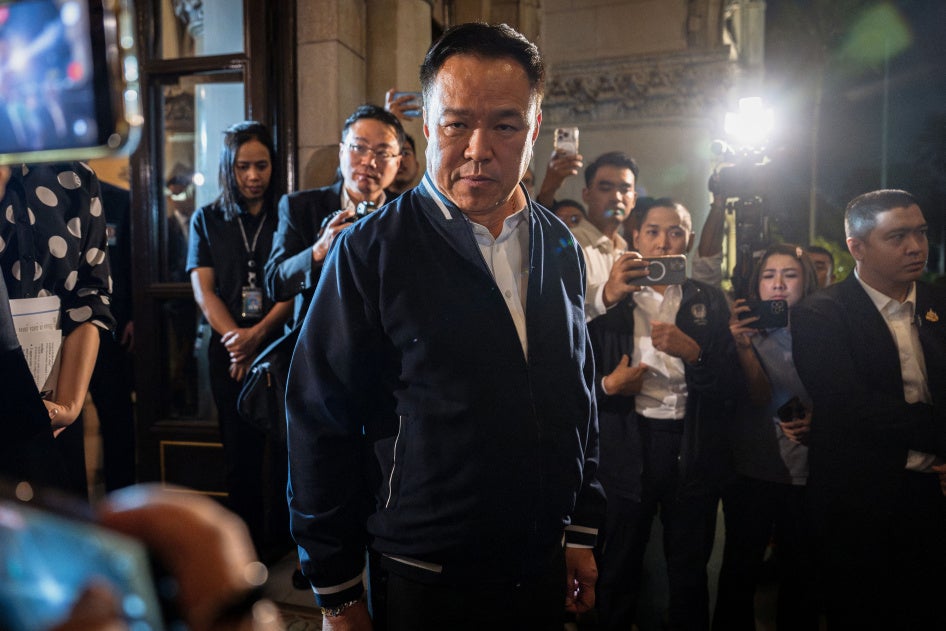
(Bangkok) – The Thai government of Prime Minister Anutin Charnvirakul has done little to improve respect for human rights in the country, Human Rights Watch said today in its World Report 2026.
A new election was scheduled for February 8, 2026. Major concerns include judicial intervention in politics, repression of free expression, and a mixed record in regard to refugees and asylum seekers.
“Prime Minister Anutin should take concrete measures to reverse Thailand’s backsliding on human rights,” said Elaine Pearson, Asia director at Human Rights Watch. “Successive Thai governments pledged to promote and protect human rights, yet repression and abuse continue unabated.”
In the 529-page World Report 2026, its 36th edition, Human Rights Watch reviewed human rights practices in more than 100 countries. In his introductory essay, Executive Director Philippe Bolopion writes that breaking the authoritarian wave sweeping the world is the challenge of a generation. With the human rights system under unprecedented threat from the Trump administration and other global powers, Bolopion calls on rights-respecting democracies and civil society to build a strategic alliance to defend fundamental freedoms.
- After many years of military rule, Thailand’s elected governments have been short-lived due to judicial intervention. On August 29, 2025, the Constitutional Court dismissed then-Prime Minister Paetongtarn Shinawatra, alleging her leaked telephone call with Cambodian Senate President Hun Sen, when both countries were at the brink of war, was an “ethical breach.”
- Thai authorities impose tight restrictions on critical speech: Almost 2,000 people face criminal prosecution for exercising their rights to freedom of expression and peaceful public assembly. Prime Minister Anutin’s Bhumjaithai Party opposes proposals to reform lese majeté (insulting the monarchy) and grant amnesty to those charged with such offenses.
- Thai authorities arrested and forcibly returned asylum seekers and refugees to countries where they are likely to face persecution, in total disregard of concerns from the United Nations, foreign governments, and human rights groups. On February 27, 2025, the Paetongtarn government sent 40 Uyghur men to China. On November 28, Thai authorities forcibly returned to Vietnam the prominent Montagnard religious activist Y Quynh Bdap.
- In a major positive step, starting from October 2025, Myanmar refugees living in camps along the border are allowed to work legally.
- Border clashes between Thailand and Cambodia from July 24-28 and December 8-27 killed and injured civilians, including children, and damaged civilian objects, medical facilities, and religious and cultural sites.
Thailand should use its membership in the United Nations Human Rights Council, starting in 2025, to promote human rights both at home and abroad, Human Rights Watch said.