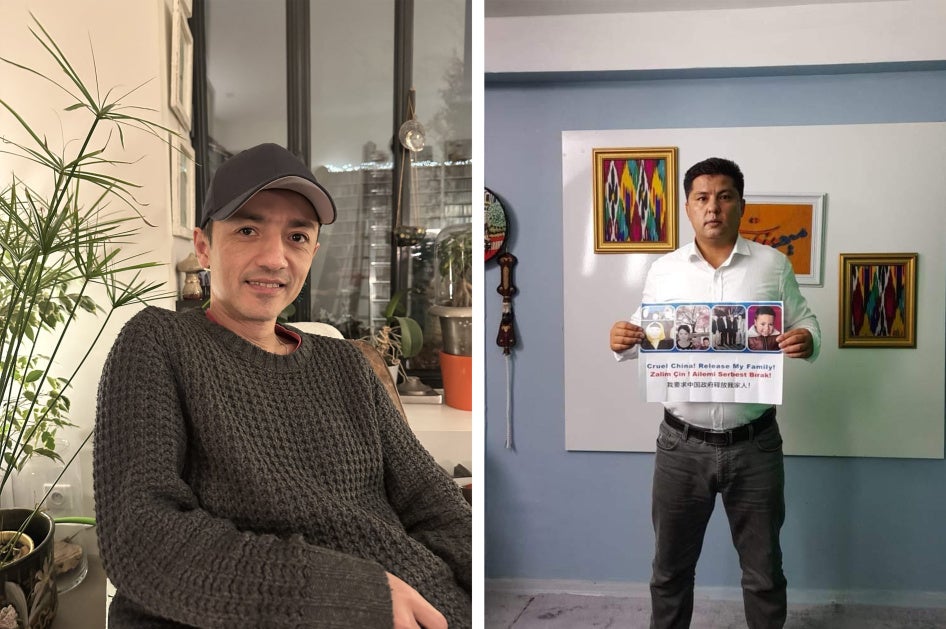
(Paris) – Chinese authorities have attempted to pressure two ethnic Uyghur activists living in Paris, including by asking one to spy on France’s Uyghur diaspora, Human Rights Watch said today. The case highlights the Chinese government’s increasing harassment of critics abroad and members of diaspora communities, abusive acts beyond China’s borders known as “transnational repression.”
“The Chinese government seeks to silence critical Uyghur voices in France through coercion, intimidation, and surveillance,” said Yalkun Uluyol, China researcher at Human Rights Watch. “French authorities should better assist Uyghurs to resist Beijing’s intimidation and surveillance by fully investigating these incidents and taking appropriate action.”
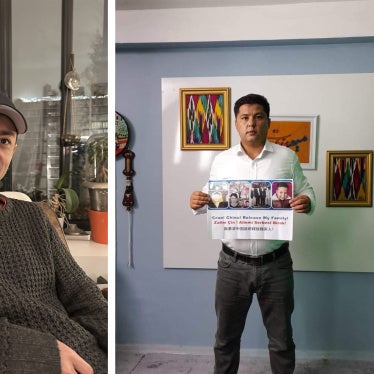
On January 15, 2026, a man claiming to be an official from Urumqi, the capital of the Xinjiang Uyghur Autonomous Region, phoned Abdurahman Tohti, 37, and tried to pressure him to monitor Uyghur community activities in France. On January 29, the same caller—whose call was recorded and made public—contacted Mirkamel Tourghoun, 42, and demanded that he stop his activism.
Tohti said the caller asked him to monitor activities at the European Uyghur Institute (Institut Ouïghour d'Europe), which works to defend Uyghur rights, preserve Uyghur language and culture, and support the Uyghur diaspora across Europe. On January 20, the institute was scheduled to hold an opening ceremony for its new headquarters in Paris. Dilnur Reyhan, the prominent Uyghur academic who founded the institute, said that the Chinese Embassy had also exerted pressure on local French authorities, who had been invited to the ceremony, not to attend.
Tohti said that the caller demonstrated detailed knowledge of his life in Paris and claimed to have spoken to several people about him. “They told me you are desperate for your family and therefore, I thought you would like some help,” the caller told Tohti. “I can let you speak to your family, even reunite with them abroad.”
Tohti left Xinjiang in 2013 and has lived in France with refugee status since 2022. He has had no contact with his family since 2016, the beginning of the Chinese government’s abusive Strike Hard Campaign in the region. In June 2025, he obtained credible information that his father, mother, wife, and sister had all been sentenced to prison terms of from 20 to 25 years for “inciting ethnic hatred and ethnic discrimination,” a vague offense that the Xinjiang authorities use to punish peaceful expression of Uyghur identity. Tohti still has no information about his two children, who are believed to have been held for a decade in state-run orphanages, or his three other siblings.
Tourghoun is a Uyghur musician, filmmaker, and activist who came to France as a student in 2005 and sought asylum after Chinese authorities detained and interrogated him for filming in the Xinjiang region city of Kashgar right after the 2008 Beijing Olympics. The man who called him on January 29 tried to get him to reconsider his activism: “[Y]ou’ve reached the bottom…. What if we get rid of all this [political] pressure, and allow you to return and see your parents? Do you have such plans?”
Tourghoun, who made a recording of this conversation and posted it online, said that Xinjiang authorities had previously “forced my family to tears over the phone while asking for information about other Uyghurs and telling me to stop activism and comply with the government.” He said he refused the offer from the official to restore communication with his family because he wants “to put an end to the psychological torture.”
Human Rights Watch sought comment about the situation from the Chinese Embassy in Paris and the French Ministry of the Interior, but they have not responded.
In October 2025, following a complaint by the Chinese Embassy, a French court convicted Dilnur Reyhan for committing “damage to public property” after she reportedly threw red paint on a banner belonging to the Chinese Embassy at a music festival near Paris.
In July 2025, Chinese authorities arrested Tara Zhang Yadi, a Chinese student who had been studying in France, upon her return to China. She faces up to 5 years in prison, or up to 15 if found to be a ringleader, under charges of “inciting others to split the country and undermine national unity,” because she advocated for Tibetan rights while in France.
In January 2025, France’s domestic intelligence agency issued a memo identifying transnational repression as a national security threat that undermines the rights of people living in France and saying it would be treated as a government priority.
In June 2025, the United Nations Office of the High Commissioner for Human Rights released a report on transnational repression urging host governments to “conduct systemic investigations and establish effective mechanisms” to counter the practice. That month, leaders of the Group of 7 (G7) industrialized democracies issued a joint statement on transnational repression pledging to build global understanding, develop a resilience and response framework, and support targeted individuals. French President Emmanuel Macron should push for a coordinated action to materialize those promises during the G7 Summit in June, which is to be held in France.
The French government should adopt a rights-respecting legal framework and policies to address transnational repression. The authorities should investigate and appropriately prosecute those responsible for criminal offenses, while ensuring protection for targeted individuals and communities.
“The French authorities should take all necessary measures to press the Chinese government to end all forms of transnational repression in France,” Uluyol said. “France should use its leadership role at the upcoming G7 Summit in Paris to develop a coordinated response to China’s abusive tactics.”