The Trump administration this week announced its intention to withdraw the United States from over 60 international organizations, conventions, and treaties, including the United Nations Framework Convention on Climate Change (UNFCCC) and the Intergovernmental Panel on Climate Change (IPCC), the UN’s leading climate science body. The move comes amid a broader retreat from international climate engagement framed by the administration as inconsistent with US national interests.
Addressing greenhouse gas emissions, rising temperatures, and climate-driven disasters requires global cooperation, shared scientific understanding, and collective accountability through reporting and public scrutiny. Withdrawing from multilateral climate institutions weakens progress on these efforts and is likely to have severe human rights consequences.
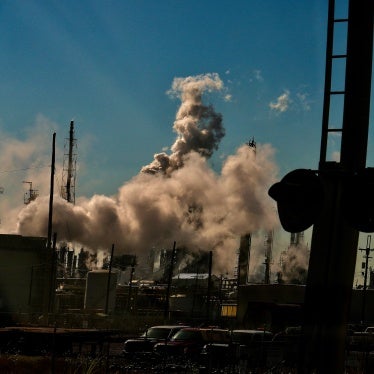
Climate change is already threatening the rights to life, health, food, water, housing, and a healthy environment. In the United States, fenceline communities living near fossil fuel and petrochemical facilities bear the brunt of policy choices that devastate their health, lives, and environment.
UN climate processes have also supported national adaptation planning in countries such as Bangladesh and Fiji, where governments have laid out plans for safer housing and disaster preparedness for communities exposed to floods, cyclones, and rising seas.
In his UN General Assembly speech in September 2025, President Donald Trump dismissed climate-friendly policies and renewable energy as a “scam.”
While the UNFCCC has limitations, it provides a widely used framework for reporting and review through which governments’ climate actions are documented and assessed. US withdrawal would limit participation in these processes and reduce international scrutiny of its climate-related actions and impacts, including on human rights.
Although the administration has already pulled the United States out of the Paris Agreement, leaving the UNFCCC is more significant as it strips the government of its role in negotiations that continue to shape global rules on emissions reporting, carbon markets, adaptation, and climate finance.
While progress on climate action is increasingly happening outside the UNFCCC through courts, domestic regulation, cross-border climate initiatives, and supply chain standards, they cannot adequately meet the near-universal participation, where scientific findings and state responsibilities are examined transparently, with formal and structured opportunities for civil society engagement that the convention has offered.
International cooperation to a crisis that knows no borders is indisputable. Governments should be strengthening, not dismantling, global frameworks to cut emissions, adapt to climate impacts, and accelerate a just transition away from fossil fuels toward renewable energy.