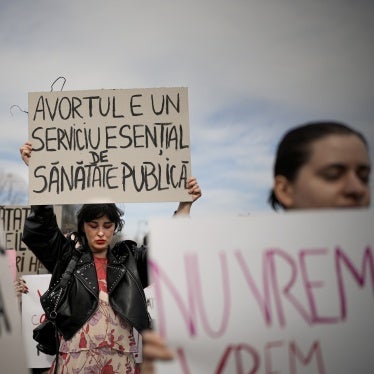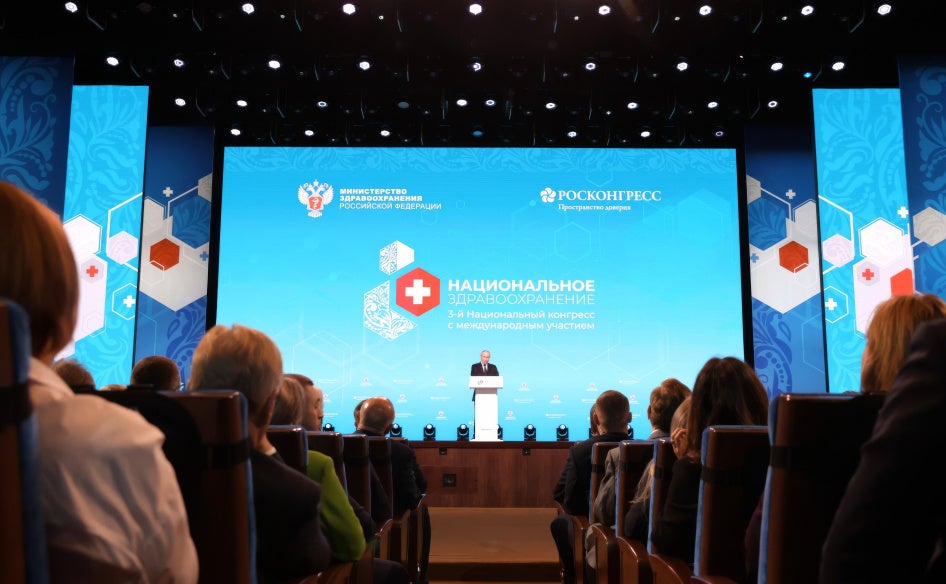
- Russian authorities are restricting access to safe abortion care and limiting the ability of women and girls to get accurate information about their reproductive choices.
- Russian authorities are jeopardizing women’s rights, health, and even lives, as part of their harmful “traditional values” crusade and effort to boost population growth.
- These policies reduce access to quality medical care and violate the right to the highest attainable standard of physical and mental health. Russian authorities should bring their policies and regulations in line with international law and reproductive care standards.
(Berlin) – Russian authorities are restricting access to safe abortion care and limiting the ability of women and girls to get accurate information about their reproductive choices, Human Rights Watch said today.
Authorities at all levels have openly pressured private clinics to stop performing abortions, toughened licensing requirements, revoked their licenses, and reclassified drugs used in medical abortion as controlled substances, making them harder to access. The Health Ministry’s 2025 guidelines for medical professionals, applicable to both public and private facilities, pressure women seeking an abortion to continue the pregnancy.
“Russian authorities are jeopardizing women’s rights, health, and even lives, as part of their harmful ‘traditional values’ crusade and effort to boost population growth,” said Holly Cartner, deputy program director at Human Rights Watch. “Although abortions in Russia are not banned outright, accessing this essential health service is becoming increasingly difficult.”
An analysis of government data exposes an egregious increase in restrictions on abortion care since 2023. There has been a dramatic drop in the number of facilities willing and able to provide such care, undermining women’s and girls’ rights to life, to health, and personal autonomy.
Although abortion is still legal in Russia, authorities have banned the “promotion” of a “child-free lifestyle” and, in many regions, “incitement” to abortion. In October 2025, the government announced the imminent creation of a special register to track pregnancies and their outcomes, which would violate women and girls’ right to privacy.
Access to safe abortion care is a core public health and human rights concern. Denying access to abortion is a form of discrimination and jeopardizes a range of human rights, including to life, health, and information; to freedom from torture and cruel, inhuman, and degrading treatment; to privacy and bodily autonomy and integrity; and to decide the number and spacing of children. Abortion bans force pregnant people to self-manage abortion or travel greater distances for abortion care. Such bans are harmful to women’s and infant health, including resulting in increased mortality.
In recent years, with the birth rate reaching the lowest numbers in decades, the Kremlin has advanced the ideology of “traditional family values,” which presents a family strictly as a heterosexual pair with multiple children and designates a woman’s role primarily as that of wife and mother. When promoting 2024 as “Year of the Family” in Russia, President Vladimir Putin emphasized that, “The main purpose of the family is about having children, about procreation, and thus, the perpetuation of our people and our centuries-old history.”
In Russia, abortion care is legal up to 12 weeks on request, up to 22 weeks in cases of rape, and at any time for valid medical reasons. Abortion is free under the country’s universal health insurance in public facilities and for a fee in private commercial clinics licensed to provide abortion care. Reproductive services are guaranteed as part of the right to health under Article 12 of the International Covenant on Economic, Social and Cultural Rights.
Russia enforces a waiting period of two to seven days, depending on the term of pregnancy, between the initial medical consultation and the abortion, ostensibly to prevent women from “making a rash decision,” but which in reality is often used to pressure women to reconsider, in line with the Health Ministry’s mandatory counselling guidelines. Mandatory waiting periods delay abortion and create logistical hurdles by requiring multiple visits to a clinic. These obstacles can be especially harmful for those already facing significant barriers, including adolescent girls.
Russian law allows girls ages 15 to 17 to access abortion independently in public health facilities, but younger girls need a parent or guardian’s authorization. Under civil law, girls under 18 need parental or guardian consent to receive any health services in private clinics, including abortion care. Parents or guardians can request and receive health information on their children, including on pregnancy, until the child turns 18. Human Rights Watch has documented extensively that forced parental involvement in abortion exposes adolescents to harm and delays their care.
Regional authorities across Russia, following federal efforts to boost birth rates, have increasingly pressured private clinics to give up their abortion licenses, resorting to threats or coercion. This pressure, coupled with burdensome requirements on the clinics, severely limits the availability and geographical accessibility of abortion care. Over 200 clinics across the country have lost their licenses to perform abortion since 2023, but the number that stopped providing abortion services is even higher. In January, Fyodor Lukyanov, head of the Patriarchate’s Commission on Family, Motherhood, and Childhood, under the leadership of the Russian Orthodox Church, reported that at least 852 private clinics had, with the “assistance” of governors and the church, “voluntarily” stopped providing abortion care. In some regions, the availability of abortion services decreased radically.
Vologda region has put in place a de facto ban on abortion, forcing women to travel to another region, which is especially hard for those from rural areas, those with low incomes, and young and marginalized women, who often already face the greatest barriers to accessing care.
The government’s policy to promote population growth has led to public hospitals increasingly pressuring women to continue their pregnancies, including during mandatory consultations following a request for abortion. Clerics sometimes participate in these consultations, arguing that abortion is killing and therefore, a grave sin.
In many regions, government authorities offer medical professionals financial and other incentives to convince women to continue a pregnancy. Some medical professionals have incorrectly told women that abortions very often cause infertility. Mandatory counseling, biased information, and the involvement of clerics in clinical decision making are inconsistent with World Health Organization (WHO) guidance and violate standards of informed consent and noncoercion.
Discussion of reproductive autonomy and abortion is increasingly under attack, and anti-abortion rhetoric is rampant in Kremlin-controlled media. In 2024, the State Duma outlawed “child-free propaganda,” and in January 2025, a court fined a woman under this law for a social media post with a photo of a prominent film director who supposedly wanted to “make movies, not children.” Since 2023, regional legislators in at least 25 regions made “incitement to abortion” a punishable offense, and a similar federal draft is under discussion at this writing. In December 2025, a judge in Saransk fined a local resident under the region’s “incitement to abortion” ban for offering to pay for his partner’s abortion.
These policies are reducing access to quality medical care and violate the right to the highest attainable standard of physical and mental health. Restrictions on discussion of and access to reproductive rights, including family planning and abortion information, violate the right to freedom of expression.
“Access to quality reproductive care, including safe abortion, is a human right,” Cartner said. “Russian authorities should bring their policies and regulations in line with international law and reproductive care standards.”
For additional details, please see below.
Methodology
Human Rights Watch generated data on the number of facilities licensed to conduct abortions by comparing the October 2025 register of medical licenses to an archived version dated October 2023, provided by the Center for Data and Research on Russia, a research group. A researcher coded the facilities as either public or private, and their locations. Based on this data, Human Rights Watch found evidence of a significant reduction in the number of both private and public facilities licensed to conduct abortions.
The data does not allow researchers to establish how many, or which clinics lost their licenses due to the authorities’ intervention, gave up their licenses in light of new, more cumbersome and costly requirements coupled with pressure by the authorities (ad hoc inspections, hostile rhetoric, etc.), or gave up their licenses for other reasons. The data also does not provide information about how many facilities still provide abortion care in practice.
Human Rights Watch also sourced information from media reports, databases of regional laws, data from the state procurement portal, and government statistics through November 2025. The researchers did not interview affected women or medical professionals to avoid putting them at greater risk but included relevant comments from social media.
Growing Number of Clinics Refuse Abortion Services
Since 2017, Russian medical facilities have been required to have a specific license to provide abortion care. Recently the government has intentionally strictly enforced onerous licensing requirements, which include having an operating room, an in-patient ward, an anesthesiologist, and an emergency care doctor in attendance, and healthcare protocols, such as mandatory psychological consultations. During this period, over 200 medical facilities have terminated or lost their licenses. The licensing burden may disincentivize clinics and hospitals from providing this essential health service.
In seven Russian regions and in Russia-occupied Crimea, not a single private clinic is currently licensed to provide abortion services, based on Human Rights Watch’s analysis of the licensing register maintained by the Federal Service for Surveillance in Healthcare. The head of Crimea’s Health Ministry under occupying authorities said that, as a result of their “deliberate, systemic work,” the last remaining private clinic in Crimea, where almost 2 million people live, stopped performing abortions in 2025. In October 2023, Crimea had 11 clinics licensed to provide abortion care.
Between 2023 and 2025, authorities in the Tver region, with a population of 1.2 million, and the Republic of Mordovia, with a population of 759,000, terminated abortion licenses in all local private clinics, 17 in Tver and 11 in Mordovia, respectively. Mordovia authorities also shut down abortion services in all public facilities except for three public hospitals in the regional capital, Saransk. In 2025, the only private clinic providing abortion care in the Magadan region, with a population of 135,000, lost its abortion license.
In the Nizhny Novgorod region, with a population of roughly 3 million, 54 out of 64 private clinics lost abortion licenses between 2023 and 2025. Between July and November 2025, 33 public hospitals in that region stopped performing abortions. In some Russian regions, private and even some public clinics still licensed to perform abortions had stopped providing the service by October 2025.
In March 2024, the Consortium of Women’s Non-Governmental Associations said it received numerous complaints from women in various regions that private clinics were denying abortion care. A government official in Tatarstan said that 19 licensed clinics had “voluntarily” stopped providing abortions in the region in 2023. In Zabaykalsky Krai, a region with close to a million residents, public medical facilities gave up abortion licenses en masse under pressure from regional health authorities. In 2023, 27 towns in the region had hospitals that provided abortion care, but by 2025, there were only 6.
In some cases, the authorities clearly stated their intention to restrict access to abortion. The Nizhny Novgorod region governor Gleb Nikitin, said “We are against making the path to this controversial decision [to have an abortion] simpler.”
The government’s pressure on private clinics is a core component of the efforts to curb access to abortion. Authorities in multiple regions reported that they were in negotiations with local clinics to convince them to stop performing abortions, and publicly demanded that the clinics “voluntarily” give up their abortion care licenses.
Andrei Turchak, the head of the Altai Republic, with a population over 2 million, also promised to restrict abortions in private clinics, in a post on his Telegram channel in October 2025. The last remaining private clinic providing abortion care in the region gave up its license after the governor publicly gave the clinic what he described as his “last warning.” Authorities also conducted inspections of clinics providing abortion care and cited many clinics for violations.
The Russian Orthodox Church has long advocated an abortion ban and works closely with the government by aggressively condemning abortions in their public rhetoric, suggesting legal initiatives to restrict abortions, and having priests participate in mandatory pre-abortion consultations with the aim of pressuring women to reconsider.
In October 2025, Pavel, metropolitan bishop of Primorye, called on local clinics to follow the example of 750 private clinics across the country, which he claimed had “voluntarily” stopped performing abortions; the regional governor supported the call. The head of the Patriarchate’s Commission on Family, Motherhood, and Childhood boasted that between February 2023 and January 2026, 852, or 30 percent of private clinics across Russia, stopped performing abortions.
Shrinking Access to Medical Abortion
According to the WHO, medical abortion can be safely self-managed by women, including at home, up to the twelfth week of pregnancy. However, medical abortion has become increasingly difficult to obtain in Russia, despite being recognized as safe and effective, typically using mifepristone and misoprostol. In 2024, the Health Ministry reclassified them as controlled substances, with the heavier requirements making their procurement and use more burdensome, and the increased probability of ad hoc inspections and penalties for alleged violations.
Mifepristone and misoprostol are part of the list of essential medicines by WHO, meaning that countries should provide them as part of their core obligations to guarantee the right to health, and governments should ensure that they are both available in adequate quantities and physically and financially accessible for those who need them. In light of the new restrictions in Russia, however, many clinics stopped administering mifepristone and misoprostol. In July 2025, Mikhail Murashko, the Russian Federation health minister, expressed satisfaction that, due to joint efforts by the ministry and the State Duma, abortion pills were “impossible to buy and banned from sale in pharmacies” across the country.
Some public hospitals provide only procedural abortion (dilation and suction curettage), not medical abortion. Medical professionals and women in several regions reported that some doctors, instead of providing medical abortion as requested, suggested that the patient should wait and get a procedural abortion later in the pregnancy. In April 2025, the Consortium of Women’s Non-Governmental Associations said it received complaints from women whom doctors had denied medical abortion.
In 2024, 81 percent of abortions on request provided by private clinics were medical abortions, compared with only 44 percent in Health Ministry hospitals, according to government statistics. In occupied Crimea, where not a single private clinic is currently licensed to perform abortions, only 23 percent of abortions on request in public hospitals in 2024 were medical abortions. In Dagestan, the figure is 12 percent. Medical statistics show that only 15 percent of girls ages 15 to 17 who had abortions in 2024 had medical abortions, almost all through private clinics.
In 2023, the Kursk region’s Deputy Governor Andrei Belostotskiy said that four local private clinics stopped performing medical abortions and expressed hope that all the remaining clinics would do the same.
In recent years, authorities have made it harder for clinics to provide medical abortion services by enforcing burdensome requirements to have an operating room, an in-patient ward, an anesthesiologist, and an emergency care doctor in attendance.
Refusals to Provide Abortions
In February, the governor of Vologda, a region with over a million residents, publicly shared his plan to put an end to abortions in the region. Subsequently, media outlets reported that medical personnel started to systematically and arbitrarily refuse to perform the procedure, in blatant violation of Russian law. Forcing women to continue pregnancies due to systemic or arbitrary refusals violates the right to health and, as human rights bodies have found, may amount to cruel, inhuman, or degrading treatment.
When local medical facilities refuse to provide abortions, women are forced to travel to other regions to obtain abortion care. Anna Minina, a woman in Vologda region, sought an abortion in February 2025. Minina told the feminist association “ONA” that medical professionals refused to provide abortion care, forcing her to travel over 200 kilometers to neighboring Yaroslavl to access abortion care. Another local resident said in an interview that she too was denied an abortion, despite undergoing all necessary procedures and consultations, and also had to travel to Yaroslavl.
Some regional and local officials continue to enforce Russia’s law guaranteeing access to abortion. Local prosecutors issued 19 formal warnings to Vologda health care facilities over the arbitrary refusals to perform abortions and brought at least two cases against hospitals. In one case, a hospital official testified in court that the regional health ministry had verbally instructed them to stop performing abortions. Judges found both hospitals guilty and imposed fines.
However, medical personnel continued to arbitrarily refuse to provide abortion care, and the governor stated that no abortions were performed in the region in July 2025, compared with 112 in July 2024.
On the regional government’s official social media page, numerous women criticized the reported “successes” in lowering abortion rates, pointing out that women who seek abortion care end up traveling to neighboring regions, such as Yaroslavl.
Pressure on Women and Girls to Continue a Pregnancy
Authorities and healthcare providers in many regions systematically gave women and girls biased and sometimes inaccurate information to dissuade them from having abortions, creating another arbitrary barrier to accessing abortion care. In July 2025, the federal Health Ministry updated reproductive counseling instructions for healthcare providers that make it mandatory for all women requesting an abortion to undergo a “consultation.”
The explicit purpose of the mandatory psychological “consultation” is to “save” the pregnancy. These guidelines portray Russia as a “global ideological center of support for traditional spiritual values” and instruct providers to emphasize the benefits to women of early childbearing and having multiple children.
They prohibit doctors from bringing up the option of abortion. If a woman or girl nevertheless insists on terminating the pregnancy, they are required to attend another session with a psychologist who, in violation of professional principles, is often set on persuading the patient to continue the pregnancy. As a psychologist from an Ivanovo hospital described it, “we bring in a lawyer and a priest, so that the woman could make the one and only correct choice, to keep the child.” The participation of priests in such “consultations” has been increasingly reported across the country.
Tatarstan officially launched the program of mandatory “consultations” in 2024, with 64 percent of women who had sought an abortion withdrawing their requests after “consultation,” double the number in 2023, according to the region’s health minister.
Chechnya and Ingushetia reported that 100 percent of women in those regions who had requested an abortion in February to September 2025 continued the pregnancy after a consultation. Dagestan apparently experienced a sudden and sharp increase in the withdrawal of abortion requests, reporting that in August and September 2025 that 99.75 percent of women who had sought an abortion instead registered for prenatal care, compared with an average of 52 percent earlier in the year.
Mandatory counseling, biased information, and religious involvement in clinical decision-making are inconsistent with WHO’s guidance and violate standards of informed consent and non-coercion.
According to the government’s own information, authorities in multiple regions provide financial incentives to doctors for not performing abortions. For example, in Vologda, doctors receive 5,000 roubles (US$64) for each woman they “convince” to continue the pregnancy, and a bonus of 25,000 roubles ($320) after the baby is delivered. Providing financial incentives to deter women from exercising a legal medical option violates international standards on informed consent and reproductive autonomy.
Abortion is a common health intervention and very safe when carried out using a method recommended by WHO, appropriate to the pregnancy duration. However, Russian health officials and practitioners pressure women to continue pregnancies by falsely claiming that a large proportion of women experience infertility after an abortion. Some doctors and websites of medical facilities misinform their patients that 15, 20 and even 25 percent of women experience infertility following an abortion and that an abortion results in incurable psychological trauma.
Under international human rights law, everyone has the right to the highest attainable standard of physical and mental health, which includes the right to seek and receive information concerning health issues, and to make informed decisions about their health care. Government refusal or failure to use scientifically and medically appropriate research and health education to inform health policy is inconsistent with its obligations to the public and undermines the right to health.
In October, Deputy Prime Minister Tatiana Golikova announced the planned creation of a federal register in 2026 that will include all pregnant women and girls and the outcomes of their pregnancy—presumably, including abortion—“for monitoring purposes.” While Golikova emphasized that “all the data will be strictly protected,” Russian authorities have consistently failed to safeguard personal information, including medical records, and this new move threatens to undermine privacy rights and the obligation of governments to do no harm through collecting health data, which should be done with full transparency and in consultation with women and girls.
Anti-choice activists have intimidated and harassed doctors who perform abortions. They have also conducted “inspections” of medical facilities during which they attend pre-abortion consultations under false pretences and then report to the authorities whether doctors, in their view, made sufficient efforts to convince women to reconsider. They also organized “training,” including funded by the government, for medical personnel on how to convince women to continue the pregnancy.
Bans on “Incitement to Abortion”
Since 2023, 25 Russian regions have made “incitement to abortion” a punishable offense, based on a Human Rights Watch review of regional legislative databases. Under these laws, individuals face fines of up to 50,000 roubles ($632), and legal entities, up to 500,000 roubles ($6,325). Another five regions also ban incitement to abortion without any stipulated penalties. At least 19 other regional parliaments are also considering such bans.
Most bar “incitement” through deceit, persuasion, bribery, or suggestion. Six extend the definition of incitement to “other” methods, creating additional risk of broad and arbitrary application. The head of the State Duma Committee on Family Protection criticized the definition in regional legislation as “unclear,” expressing concern that it could apply even to discussions with close relatives, but this has not led to any changes in these laws.
In December, a judge in Saransk fined a local resident 5,000 roubles ($63) under Mordovia’s “incitement to abortion” ban. The charges stemmed from allegations by his partner that he offered to pay for an abortion when she told him she was pregnant with twins. Mordovia was the first region to outlaw such “incitement” in 2023.
Legislators are already discussing the introduction of a similar federal law. Russia’s federal “gay propaganda” law, adopted in 2013, had been preceded by “gay propaganda” prohibitions in several regions.
In November 2024, Russia adopted a law to ban “childfree [lifestyle] propaganda.” In December 2024, anti-extremism police in Russia-occupied Sevastopol brought charges under the law against a woman over her old social media post that supposedly promoted “forgoing childbearing in favor of a carefree lifestyle.” The “offending” post, which the authorities described as “misanthropic,” featured a photo of a prominent film director who supposedly wanted to “make movies, not children.” In January 2025, a Russia-installed court fined her 50,000 rubles ($632).
Russia’s Obligations Under International Human Rights Law
As a party to the International Covenant on Economic, Social and Cultural Rights Russia has legal obligations to respect, protect, and fulfill the right to the highest attainable standard of physical and mental health. These include the duty to ensure the availability, accessibility, acceptability, and quality of health facilities, goods, and services. This requires states parties to ensure “the right to seek, receive and impart information and ideas concerning health issues.”
In its General Comment No. 22 on the right to sexual and reproductive health, the Committee on Economic, Social and Cultural Rights said that the right to sexual and reproductive health is “indivisible from and interdependent with other human rights” and “essential to the realization of the full range of [women’s] human rights.” It has also specified that sexual and reproductive health care and information should be characterized by non-discrimination; physical, financial, and information accessibility; and a lack of barriers.
Both this committee and the committee that oversees compliance with the Convention on the Elimination of All Forms of Discrimination against Women found that denying women and girls access to safe abortion, including abortion on request, can violate their rights, including their rights to life and health. In some cases, barriers to abortion access may even amount to cruel, inhuman, and degrading treatment.
The CEDAW Committee has highlighted that failing to provide necessary services that specifically affect women constitutes a violation of reproductive rights and discrimination. To comply with these international standards, states need to dismantle discriminatory practices and legal restrictions that prevent equitable access to reproductive health services. The treaty also requires states to eliminate discriminatory gender stereotypes, including those that portray women primarily as mothers, which underpin many of Russia’s current policies and narratives on “traditional values.”