
In this article, the author examines how Iraq’s Personal Status Code has weakened legal safeguards for women and girls, particularly by facilitating child marriage and creating a parallel religious legal regime. Drawing on court observations and survivor testimonies, the piece shows how unregistered marriages expose girls to abuse and argues that the new code erodes protections in divorce, custody, and access to civil documentation.
When I went to a Baghdad court in May 2023 to interview a judge, I wasn’t expecting to witness a child marriage.
The judge had agreed to speak with Human Rights Watch about unregistered marriages – marriages officiated by a religious leader but never registered with the Personal Status Court. Culturally, these marriages are often considered valid, but they hold no legal weight unless the couple certifies the marriage at the Personal Status Court.
The judge answered our questions and explained the procedure to certify a marriage contract. He insisted that it was a straightforward procedure, and in fact, he would show us just how simple it was.
He donned his robes, called on his assistant to bring in the next couple in line, and brushed aside our protests about their privacy.
In walked a 17-year-old girl, visibly pregnant, with her father and 20-year-old husband. The couple had married a year earlier without officially registering the marriage and were seeking to legalize their marriage ahead of the birth of their child. Without deeper inquiry into the circumstances of the marriage and wishes of the underage bride, the judge asked her, her father, and her husband whether they consented to the marriage and then certified it.
Earlier, the judge had told me that child marriage was the primary driver of unregistered marriages officiated by religious leaders outside the court. In 2021, the UN Assistance Mission in Iraq, UNAMI, reported that 33.9 percent of marriages in Iraq are unregistered, with 22 percent of them involving girls under the age of 14.
Often, parents wishing to marry off their underage daughters would opt for a religious marriage first, then get the marriage certified by the Personal Status Court once she turns 18 or gets pregnant.
When such a couple present themselves before the court, especially if the wife is already pregnant, the judge finds himself before a fait accompli. Without the marriage certificate, the bride would not be able to give birth in a government hospital. Their child would not be able to get a birth certificate and would be at risk of statelessness.
On the other hand, ratifying the religious marriage contracts of girls under 18 weakens the rule of law and undermines efforts to reduce child marriage in Iraq.
Caught between a rock and a hard place, most judges opted to legalize these marriages.
Child marriage is a key driver of unregistered marriages in Iraq.
In 2021, UNAMI reported that 33.9% of marriages in Iraq are unregistered, and 22% involve girls under the age of 14.
When I witnessed this predicament, religious marriages outside the courts were illegal under the Personal Status Law (No. 188 of 1959). But in January 2025, parliament passed an amendment legalizing them. This move effectively created a parallel and contradictory personal status regime. Couples concluding a marriage contract can now choose whether the provisions of the Personal Status Law of 1959 (PSL) or the new Personal Status Code, developed by the Ja’afari school of Islamic jurisprudence, would govern any marriage, divorce, inheritance, and custody issues they might face.
By making a person’s rights and protections contingent on religion, not citizenship, the law erased the right of equality before the law. For example, the daughter of an Iraqi Sunni family will inherit land after her parents’ passing, yet her Shia neighbor will be denied this right.
For women and girls now governed by the Personal Status Code, several of their rights and protections have been removed entirely. The Code facilitates child marriage, strips away protections for women and children in and after divorce, and leaves unresolved bureaucratic questions that place basic rights at risk.
Married too young, protected too little
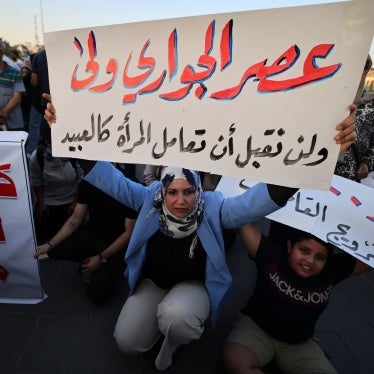
When the amendment was first introduced in parliament in August 2024, it was met with immediate domestic and international backlash over fears that it would allow child marriage for girls as young as 9.
Due to the tireless campaigning of Iraqi women’s rights groups, the final text said that the minimum age of marriage in the Personal Status Code could not contradict what was already written in the Personal Status Law of 1959, which sets the minimum marriage age at 18, or 15 with a judge’s permission and depending on the child’s “maturity and physical capacity.” This already contravenes the evolving consensus in international law that 18 should be the minimum age for marriage.
At the time, the inclusion of this age limit was considered a limited but important victory for women’s rights groups. Through their efforts, they were able to take the law from terrible to just bad.
But six months later, the text of the Personal Status Code approved by parliament in August 2025 allowed for marriage at “puberty,” which could be considered as young as 9 or 10. Basing marriage eligibility on puberty directly conflicts with the Convention on the Rights of the Child, which defines a child as anyone under 18 and obliges governments to protect children from harm. Child marriages are a form of gender-based violence and are recognized internationally as a harmful practice. They often result in the violation of other human rights, including married girls’ right to education, freedom from violence, reproductive rights, access to reproductive and sexual health care, employment, freedom of movement, and the right to consensual marriage.
Parliament approved the Code without any meaningful effort to ensure its conformity with Iraqi and international law. By empowering religious leaders to conclude marriage contracts without state involvement or oversight, the amendment turned what had been an illegal workaround into sanctioned practice.
Today, Iraqi girls are paying the price of parliament’s failure to protect them.
An investigation by the Sunday Times found that the amendment to the PSL is creating a black market exploiting vulnerable girls, showing that videographers, make-up artists, and dress sellers in Baghdad are reporting a boom in the capital’s wedding industry, attributing the recent boost in business to a rise in child bride clients.
Lost protections in divorce, parental responsibility
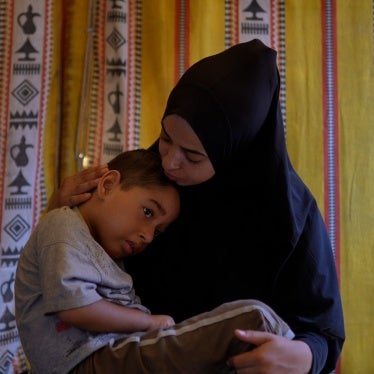
In October 2025, we interviewed Ghazal H., whose case demonstrates how the new legal framework harms women. In December 2015, Ghazal was finally able to divorce her violent husband, but her victory was bittersweet. The judge who granted her divorce reduced her deferred dowry from 50 million Iraqi dinars ($38,100) to 25 million ($19,500) with the justification that Ghazal had “caused her husband harm” by filing a domestic violence case against him.
Still, Ghazal told us at the time that she was happy to leave with her son.
A decade later, on September 11, 2025, Ghazal received a court summons notifying her that her ex-husband had filed a lawsuit to retroactively apply the Ja’afari Personal Status Code to their marriage contract and to terminate her guardianship of their 10-year-old son. She said he had done so without her knowledge or consent.
Under the Personal Status Code, parental responsibility is automatically transferred to the father at age seven or if the mother remarries, without consideration for the child’s best interests, as international law requires. These rigid rules ignore the emotional bonds, psychological development, and caregiving realities of children, often resulting in forced separation from primary caregivers and lasting psychological trauma.
Such provisions allow parental responsibility to be used as a punitive or retaliatory tool against women. Mothers may be pressured into remaining in harmful relationships or not remarrying to avoid losing their children, and fathers may seek parental responsibility as leverage in marital disputes.
Ten years later, Ghazal was summoned to court. Without her knowledge or consent, her ex-husband had filed a case to retroactively apply the Ja’afari Personal Status Code to their marriage—and to end her guardianship of their 10-year-old son.
Assessments concerning children’s future should instead be based on the best interest of the child, which should include hearing from the child themselves, as required by Art. 12 of the Convention on the Rights of the Child, rather than fixed age thresholds or the mother’s marital status.
Further compounding these harms, under articles 70 to 74 of the Personal Status Code, a judge may only approve a wife’s filing for divorce if she claims abandonment, non-maintenance, or repeated physical abuse. The judge’s ruling must be approved by a religious authority, who can overrule the judge. These provisions exclude psychological, sexual, and economic abuse, which are widely recognized as core forms of domestic violence.
By requiring women and girls to prove “repeated” physical abuse – to both a judge and religious authority – and excluding other forms of harm, the framework implicitly permits violence within marriage. This effectively normalizes abuse by suggesting that violence is legally acceptable until it crosses an undefined threshold, rather than affirming a woman or girl’s unconditional right to bodily integrity and safety.
By requiring proof of “repeated” physical abuse to file for divorce, the Code normalizes violence instead of preventing it and forces mothers to choose between safety and their children.
Human rights standards categorically reject this logic. Under the international Convention on the Elimination of All Forms of Discrimination Against Women (CEDAW) and its General Recommendation No. 35, all forms of gender-based violence constitute discrimination and require immediate state protection and access to remedies, including divorce, without excessive evidentiary burdens. These provisions place Iraq in breach of its international obligations by failing to prevent violence, protect survivors, and ensure effective access to justice.
Religiously valid, but legally useless
Iraq’s new system is now an outlier in the Middle East region. Under Egypt’s Personal Status framework, for example, authorized religious officials are empowered to conclude marriage contracts but are required to record the marriage in official registers and submit the documentation to the competent Personal Status Court. In practice, this means religious leaders act as state-recognized registrars, not parallel authorities.
In Iraq, however, the amendment gave religious leaders authority comparable to that of judges, but without similar obligations and duties. Unlike judges, religious leaders are not required to ensure marriages they conclude are documented, traceable, and subject to judicial oversight. Moreover, the Code now allows marriages to be concluded verbally, without witnesses, registration, or even a religious leader present.
This is particularly concerning given the downstream implications of failing to register one’s marriage at the Personal Status Court and obtain a civil marriage certificate.
Civil documentation is still required to access most public services and social protection schemes in Iraq, including education, health care, employment, food distribution, and housing. Without a civil marriage certificate, women and girls cannot update their civil status on official identification documents, effectively barring them from services tied to marital status.
Proof of marriage is still required to give birth in government hospitals, transfer a deceased husband’s social benefits to his wife, and access social protection programs such as monthly stipends for widows, divorcees, and abandoned wives under Social Protection Law No. 11 of 2014.
To get a marriage certificate, a couple must present themselves before the Personal Status Court and provide two witnesses, the acknowledgment by both parties of the marriage, and the wife’s acknowledgment that consummation occurred. This process can become more complicated, and sometimes impossible, in cases where the husband dies, abandons or divorces his wife outside the court, or denies the marriage.
Prior to the passage of the amendment, issues of civil documentation plagued women in unregistered marriages. By failing to bridge the disconnect between religious and legal validity of marriage, more women and girls married under the Personal Status Code will likely see their rights to government services and social protection erode. By passing this code, Iraq put women and children’s rights back decades. The negative repercussions of stripping away legal protections are already being felt. Iraqi authorities should urgently repeal this law.