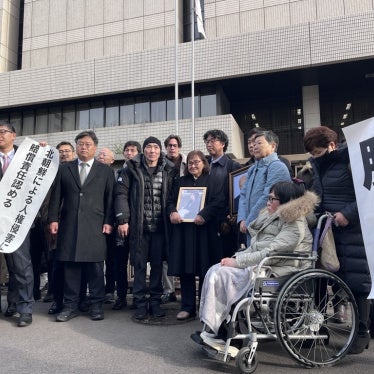
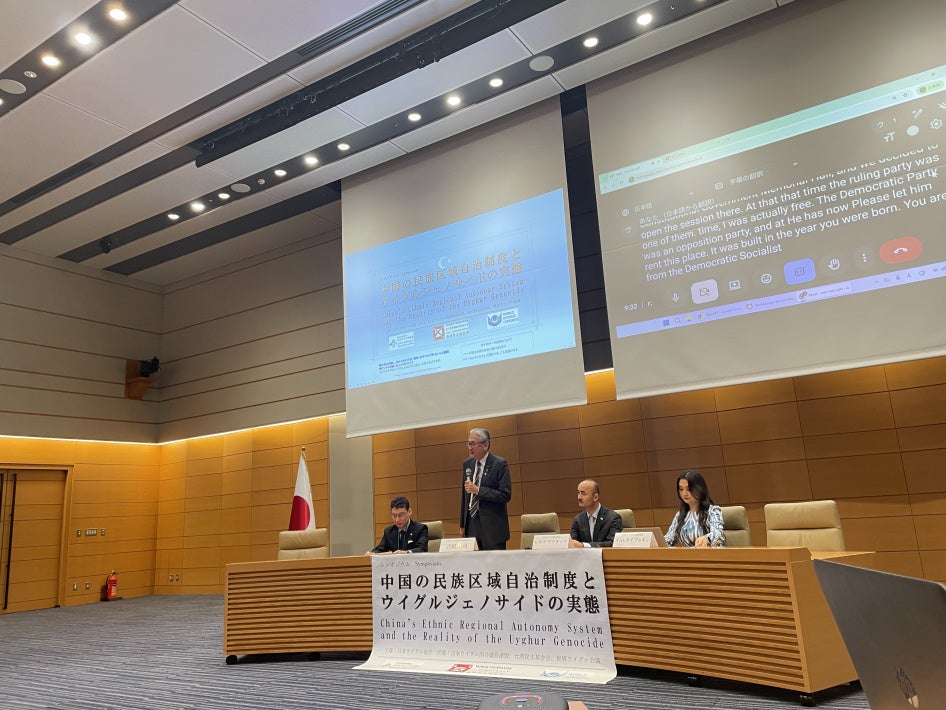
Japanese lawmakers and Uyghur activists gathered on February 25 at an event hosted by the Japan Uyghur Association in Tokyo to address the Chinese government’s atrocity crimes in the Xinjiang Uyghur Autonomous Region.
“It’s important to send a big message to the world” about the Chinese government’s rights abuses against Uyghurs, said Keiji Furuya, a senior lawmaker for the ruling Liberal Democratic Party, in his opening remarks. Furuya, chairperson of the Japan Uyghur Parliamentary Association, said last November that his caucus would draft a Japanese version of the United States Uyghur Forced Labor Prevention Act.
Human Rights Watch, in a February 18 letter to the Japan Uyghur Parliamentary Association, underscored that import restrictions targeting state-imposed forced labor are crucial for increasing pressure on the Chinese government to end abusive labor practices in Xinjiang and beyond.
Human Rights Watch recommended that Japan should target any global region with a high risk of state-imposed forced labor. The law should also require companies seeking to import at-risk products to demonstrate that a product was not produced through forced labor.
Since 2016, Chinese authorities have detained up to a million Uyghurs and other Turkic Muslims in Xinjiang’s political reeducation camps, sentenced a half-million to prison without due process, and subjected many to torture, forced disappearance, mass surveillance, cultural and religious persecution, family separation, and forced labor. State-imposed forced labor in Xinjiang affects global supply chains, including in Japan, in sectors including automotive, solar panels, apparel, seafood, agricultural products, and critical minerals.
The Japanese government has long been critical of Beijing’s abuses against Uyghurs. In 2024, during China’s fourth Universal Periodic Review (UPR) at the United Nations Human Rights Council, as well as during a 2025 bilateral meeting with President Xi Jinping, Japan expressed concern about China’s human rights situation, including in Xinjiang.
Import restrictions and other corporate accountability laws, such as the European Union’s corporate sustainability due diligence directive, are essential to integrate human rights with economic policies that protect consumer and local industries from “low rights” economic models in China and beyond.