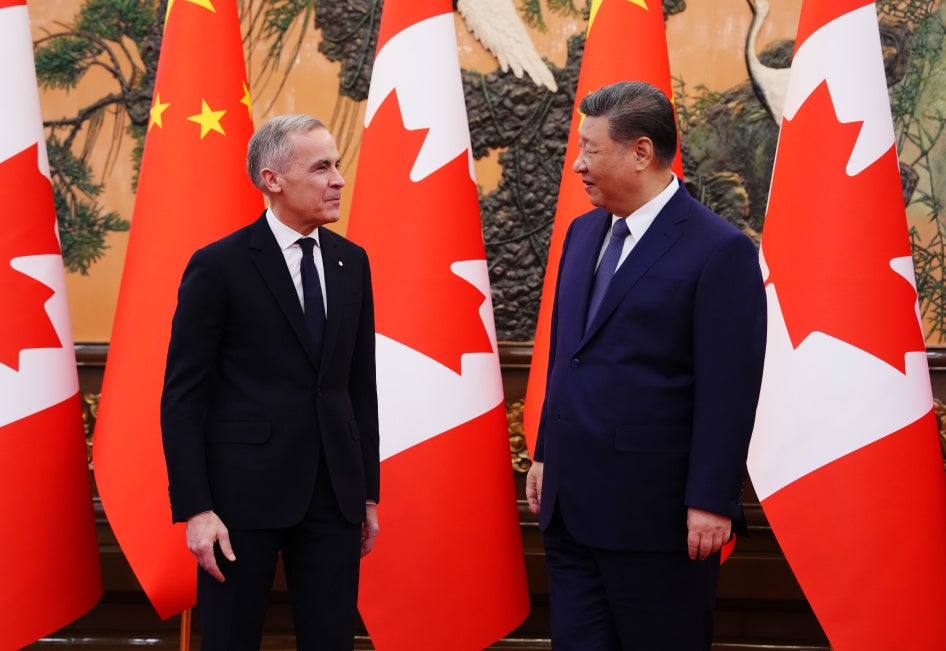
The first year of Donald Trump’s second term appears to have made China, not America, “great again.” Facing Mr. Trump’s volatility, many governments are seeking to diversify their economic ties by pivoting toward more stable-seeming China. When Prime Minister Mark Carney visited Beijing in January, he even proclaimed that a strengthened China-Canada partnership would be part of a “new world order.”
But he, like other Western leaders visiting Beijing, made little mention of China’s horrendous human rights record. Indeed, at the World Economic Forum, he argued that Canada would “take on the world as it is, not wait around for a world we wish to be.”
Underlying such statements is a growing sidelining of universal rights. That aligns perfectly with Beijing’s interests.
Early in Xi Jinping’s presidency, the Chinese Communist Party identified “universal values” like human rights, democracy and media freedom as existential threats to its rule. China’s foreign policy similarly rejects universal rights: Its Belt and Road Initiative does not make participation conditional on respect for human rights, labour protections or environmental standards, and its three Global Initiatives emphasize sovereignty and state authority in ways that tend to privilege government power over individual freedoms.
This rejection of universal rights is mirrored by the Trump administration’s promotion of a faith-based “natural rights” framework that selectively elevates certain rights to advance its ideological goals. These differing approaches converge in practice: international norms designed to protect human dignity are increasingly treated as irrelevant or effectively rendered meaningless.
Governments that call this approach “pragmatic” risk drifting in the same direction, and their strategies for surviving Mr. Trump’s chaos may instead hasten the arrival of the China century – one in which Beijing doesn’t just dominate geopolitics, but also makes its repressive approach to domestic governance the global norm.
A number of governments appear to view China as a stable alternative to Mr. Trump’s America. But China’s apparent stability rests on tight information control. Much of the turmoil in the U.S. is visible precisely because the country remains a functioning democracy, with a free press, independent courts and a civil society capable of challenging power. China, too, experiences chaos – witness the zero-COVID lockdowns or its heavy-handed responses to protests in Hong Kong and elsewhere – but its repressive machinery suppresses scrutiny. Recent unexplained purges in China’s senior military leadership illustrates why opacity should not be confused with stability.
Governments must resist the gravitational pull of strongmen who are gaslighting the world into believing that “pragmatism” without rights is in their interests. Respect for human rights remains critical – not just for middle-sized democracies that uphold them domestically, but for people everywhere, especially those on the frontlines pushing against authoritarianism: workers, minorities, journalists, activists.
Mr. Carney is right that middle powers need to co-operate. But a more honest “pragmatism” begins with recognizing that widespread human rights violations by a trading partner generate economic, security and governance risks.
The Chinese government’s authoritarian rule, repression and systematic denial of core labour rights – including reports of state-imposed forced labour in the largely Muslim Uyghur region – have helped produce decades of artificially cheap exports. This has helped drive a global race to the bottom in labour rights, contributing to the kind of localized job losses that have fuelled resentment and populism in Europe and the U.S.
Instead of continuing to endorse China’s “low-rights” economic model, middle-power governments looking for trade partnerships with the country should integrate human rights into their economic and foreign policies. They should enforce a level playing field by barring imports linked to forced labour and other abuses, and use existing tools – including the European Union’s corporate accountability laws and the U.S.’s Uyghur Forced Labor Prevention Act – to enact this strategy.
Governments should also invoke labour-rights protections embedded in multilateral trade agreements that China has already signed, emphasizing that widespread worker abuses deflate wages and violate core international conventions that China is obligated to uphold. Governments should curtail trade or business with Beijing-linked entities involved in abuses or surveillance. And governments should more ambitiously rethink ways to factor in China’s social and environmental costs in their trade policies.
Governments should limit entry and financial access for Chinese officials implicated in repression while offering expedited visas and safety for rights defenders. Security policies should confront China’s transnational repression, recognizing that protecting open debate and safeguarding the production of knowledge independent of the Chinese government’s censorship is as much a human rights issue as a security one.
By collectively embedding human rights into policies on trade, procurement, finance, migration and security, governments can mount an active defence – denying even superpowers the benefits of repression while sustaining human dignity in a fractured world.